
EXPLORE the Forest Massif of Odzala-Kokoua with this slideshow, check the location map and get all the facts and information below.


For slideshow description see right or scroll down (mobile). Click to view slideshow
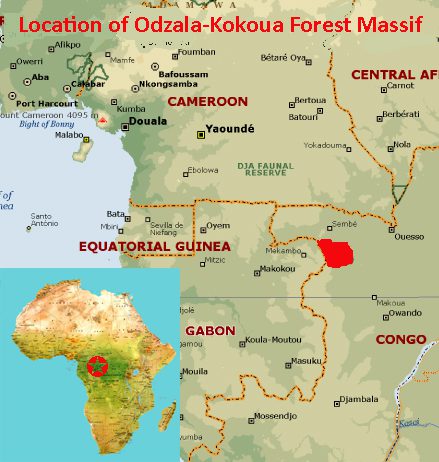
Location and Values: The Forest Massif of Odzala-Kokoua is a vast tract of virgin forest in the heart of the Congo Basin, near Congo’s north-western border with Gabon. It is characterised by extensive areas of Marantaceae forest at various stages of ecological succession, as well as unique mist forests. Across the forest landscape there are more than 130 marshy clearings (known as Bais) where large mammals congregate. The forest is home to an exceptional diversity of species, including 120 mammals and 463 birds. Notable populations of forest elephants, western lowland gorillas and chimpanzees are found, together with a remarkable 15 other species of primates.
Conservation Status and Prospects. According to IUCN’s Conservation Outlook Assessment (2025) the conservation status of the Forest Massif of Odzala-Kokoua is ‘good with some concerns’. The park is managed by the international non-governmental organization, African Parks. The IUCN report recognizes that the site itself is currently well protected and in a stable, relatively pristine condition, but it is subject to increasing levels of threats from adjacent areas. Poaching remains a major concern, as it is done at a commercial scale associated with an extensive regional bushmeat trade. Artisanal and industrial mining activities are further significant threats, exacerbated by deficiencies in the permitting systems and inconsistencies between the law and decisions of local authorities in respect of resource exploitation in and around the park.
The extreme poverty of local communities, combined with increasingly frequent conflicts with wildlife generates significant tensions. Improving the socio-economic development conditions of communities living in the immediate vicinity of the park and its buffer zone is therefore a high priority. Road infrastructure development around the park is a key element of such socio-economic development but it brings increasing pressures on the park enabling poaching and other resource exploitation, providing easy access to bushmeat markets, and encouraging increased settlement. Road development may also lead to the spread of invasive plant species and an increased risk of disease transmission between humans and wildlife.
LINKS:
Slideshow description
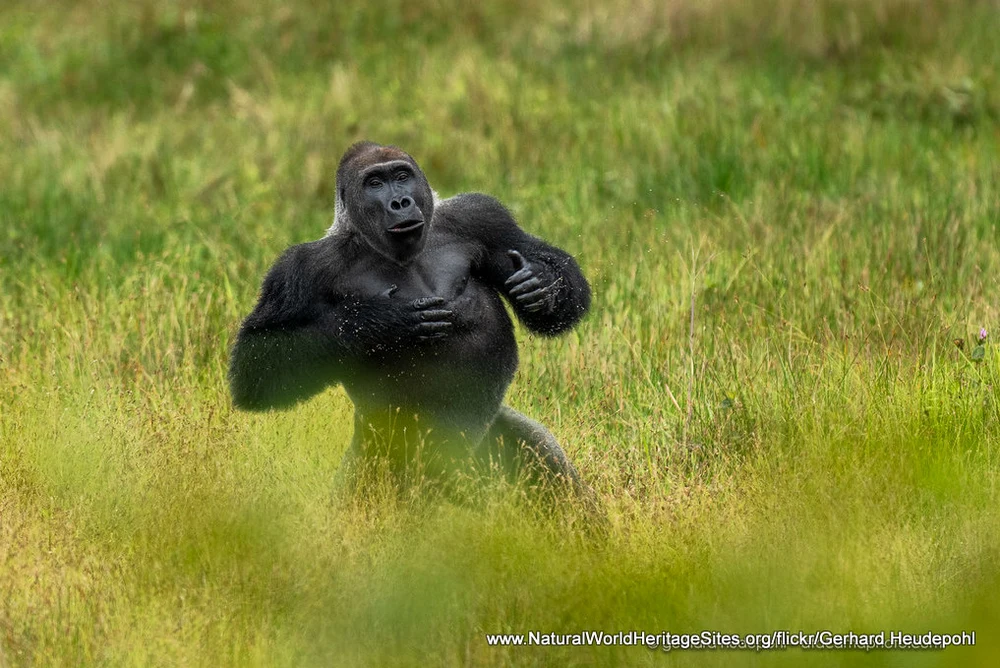
Slideshow Description: The slideshow features a short portfolio of photos illustrating some of the iconic species of wildlife – forest elephant, buffalo, western lowland gorilla, giant forest hog, sitatunga, a vast flock of African grey parrots and some wider views of two of the watery forest clearings known as ‘Bais’.
The following photographers are acknowledged with thanks for their contributions to this slideshow (sourced via Flickr and the nomination file with individual photo credits provided in the watermarks of each photo): Fondation Odzala-Kokoua African Parks; Caroline Culbert; John Friel; Adam Scott Kennedy; Gerhard Heudepohl; Jonas Eriksson; Marcus Westwood; Warren Smart, and KSHoffman.
Factfile
Website Categories:
Tropical and sub-tropical forests;
Area: 11,794 km2
Inscribed: 2023
Criteria:
- Ecological processes (ix);
- Natural habitat for biodiversity (x);
- Significant number of rare, endemic and/or endangered species (x)

