
EXPLORE the Bale Mountains National Park with this slideshow, check the location map and get all the facts and information below.


For slideshow description see right or scroll down (mobile). Click to view slideshow
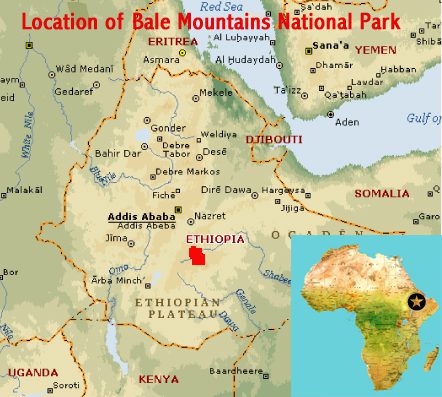
Location and Values: Bale Mountains National Park is located in the Ethiopian highlands, east of Africa’s Great Rift Valley. It is an area of exceptional natural beauty with volcanic peaks and ridges, dramatic escarpments, sweeping valleys, glacial lakes, lush forests, deep gorges and numerous waterfalls. It covers an exceptional range of altitude from Ethiopia’s second highest peak (Tullu Dimtu, 4,377m) into the southern lowlands at 1,500m, including the largest expanse of intact afro-alpine habitat in the world. More than 80% of all species found in this habitat (above 3,500m) are endemic. There are exceptional levels of endemism in all taxonomic groups, with 177 endemic species of flowering plants (out of a total of 1,660 species documented for the park), 23 endemic mammals (out of 79) and 17 endemic birds (out of 363 species). Furthermore, the forests of the Bale Mountains serve as a genetic reservoir for Wild Forest Coffee and countless medicinal plant species.
Some notable species are only known from the Bale Mountains including the Harenna Shrew, Giant Mole Rat, Malcolm’s Ethiopian Toad, Bale Mountains Tree Frog and Bale Mountains Frog. The park supports two-thirds of the global population of the endemic Mountain Nyala, the most important population of the endemic Ethiopian Wolf and is home to the Menelik’s Bushbuck, an endemic subspecies. The Bale Monkey is endemic to the bamboo belt in this part of the Ethiopian highlands.
Conservation Status and Prospects. Bale Mountains National Park is faced with several significant threats which are documented in the World Heritage nomination dossier and its IUCN evaluation. These include (1) overgrazing by livestock, (2) the impact of people living in the park on its natural resources and (3) the expansion of agriculture (which involves clearing of vegetation in the afro-alpine forest zone, leading to habitat loss and fragmentation).
In respect of the overgrazing issue, an estimated 725,000 domestic livestock were grazing on the afro-alpine habitats together with 25,000 livestock in the Harenna Forest at the time of the last estimate in 2017. Efforts are being made to reduce this excessive grazing pressure through the introduction of a Grazing Pressure Reduction Strategy (GPRS). The aim is to reduce livestock numbers to sustainable levels and gradually expand no-grazing zones through a participatory process with relevant communities. By 2023 about a third of Community Based Organisations in the surrounding villages (kebeles) are reported to have entered into agreements with Bale Mountains National Park to implement the GPRS through a community-led approach.
At the same time collaborative resettlement initiatives for people living within the Park involving a Livelihood Improvement Strategy are envisaged. Other threats to the integrity of the park and its wildlife include (1) the potential for disease transmission from domestic dogs to the Ethiopian Wolf population (2) the construction of roads, transmission lines and other infrastructure and (3) the high incidence of fires – either deliberate or wildfire – which are preventing the natural regeneration of forests. The potential impacts of climate change remain uncertain, but underline the need to strengthen natural ecosystem resilience by reducing other threats.
LINKS:
Slideshow description
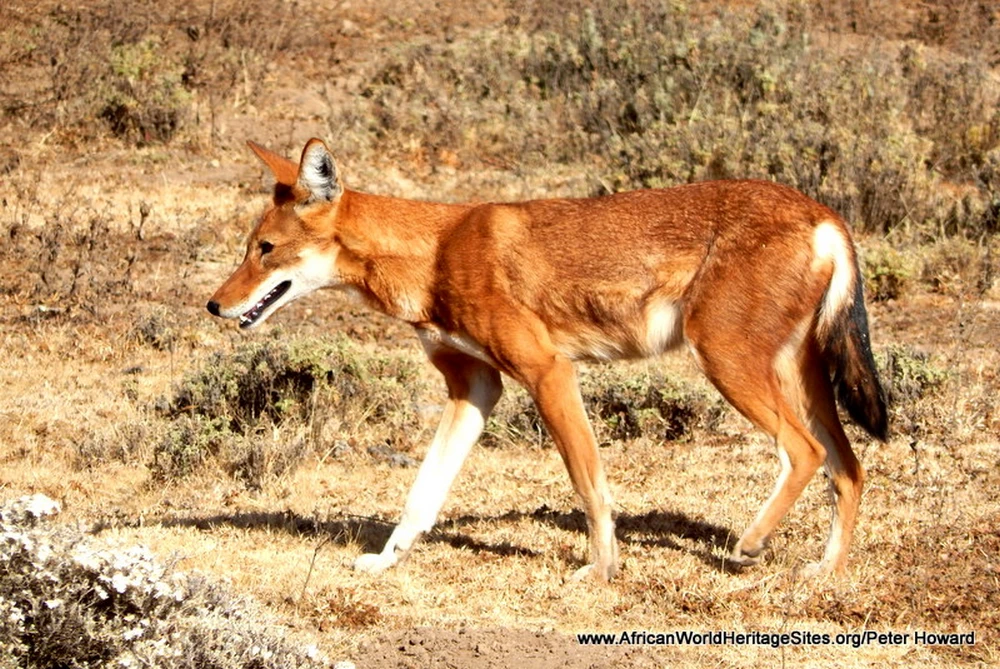
Slideshow Description: The slideshow ‘tells the story’ of the Bale Mountains National Park with a portfolio of photos that illustrate the landscape features of the park and many of its endemic species of flora and fauna. It starts with mountain views along the approach road, and some of the interesting fauna that may be encountered in the open habitats, wetlands and forests below the high plateau. Amongst these are Rouget’s Rail, white-collared pigeon, chestnut-naped spurfowl, yellow-billed duck, wattled ibis, warthog, blue-winged goose and Mountain Nyala. As you ascend higher onto the Sanetti Plateau, some magnificent mountain scenery is revealed with high alpine pools and open landscapes punctuated by giant lobelias. The grassy plateau eventually descends steeply through the Harenna Forest, where some settlement and traditional lifestyles are found. Here there are evergreen forests draped in moss, patches of bamboo forest, misty vistas and stands of red-flowered Hagenia trees where chameleons may be revealed. Returning from the lowlands the last part of the slideshow highlights further features of the high plateau, with its colourful lichen-covered rocks, expansive views and landscapes where Ethiopian wolves may be seen. The last few images convey a sense of some conservation issues showing remote settlements associated with domestic dogs, and invasive alien plants.
Factfile
Website Categories:
Area: 2,150 km2
Inscribed: 2023
Criteria:
- Outstanding natural beauty (vii);
- Natural habitat for biodiversity (x);
- Significant number of rare, endemic and/or endangered species (x)

