
EXPLORE the Lençóis Maranhenses National Park with this slideshow, check the location map and get all the facts and information below.


For slideshow description see right or scroll down (mobile). Click to view slideshow
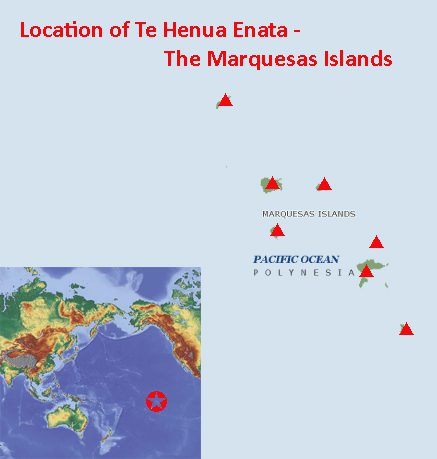
Location and Values: The Marquesas Islands are a remote volcanic archipelago of 15 islands in the tropical South Pacific about 1,500 km northeast of Tahiti. They are part of French Polynesia and known as Te Henua Enata (‘Land of Men’) in the local Marquesan language. The islands are renowned for their spectacular scenery of craggy peaks, deep valleys, waterfalls, dramatic coastlines and for their rich Polynesian culture. The World Heritage Site is a ‘mixed’ natural and cultural site with seven distinct locations spread across all of the main islands and some islets.
In terms of its natural heritage attributes, the site is scenically spectacular and a biodiversity hotspot for both terrestrial and marine life. A large proportion of the terrestrial and marine species of the Marquesas are endemic, including vascular plants, land and seabirds, terrestrial and marine molluscs, and freshwater fish. This includes species that are endemic to the archipelago as a whole as well as those that are endemic to specific islands and even specific mountain peaks. The marine environment is recognized as one of the last remaining marine wilderness areas on the planet, with some of the world’s best-preserved coastal ecosystems. The terrestrial part of the site protects two continuous vegetation corridors from summit to shore with a wide array of habitats including four distinct tropical cloud forest ecosystems. The Marquesas is one of the few known breeding sites globally for 21 species of seabirds, and several critically endangered (CR) and endangered (E) birds such as the Fatu Hiva Monarch (CR), Marquesas Kingfisher (CR), Nakuhiva Imperial-pigeon (EN) and Marquesas Ground-dove (EN). Seven endemic species of plants and 21 of the islands’ shark and ray species are classified as globally threatened.
The cultural attributes of the site include a number of archaeological remains such as monumental dry-stone and lithic sculptures as well as engravings. The Marquesas islands were inhabited by a seafaring civilization that arrived around 1000 years ago and flourished in isolation for centuries before European contact around 200 years ago. By the end of the eighteenth century a thriving Polynesian civilization had been established and the population of the islands was estimated at 50-100,000. Subsequently, European contact resulted in the decimation of the Ènata, and today the islands’ population numbers only about 10,000. The ancient Polynesian civilization is remembered through its archaeological legacy and intangible heritage.
Conservation Status and Prospects. According to IUCN’s Conservation Outlook Assessment (2025) the conservation status of the Te Henua Enata – The Marquesas Islands is ‘good with some concerns’. The most important direct threat to the natural values of the site comes from invasive alien species and the presence of feral animals (goats, cattle, horses, pigs, cats). For example rats and feral cats have caused a 98% decline in the population of the critically endangered Fatu Hiva monarch (bird), which now numbers as few as 18 individuals. Similarly, three endangered endemic species of snails have been impacted by the introduction of a carnivorous snail in the early 1900s. One of these (Samoana bellula) was once plentiful and widespread but now only found on the highest peaks, and another (Pilsbry’s Tree Snail) may be extinct.
The integrity of the Marquesas marine ecosystem is influenced by factors beyond its boundaries. The potential impacts of climate change are largely unknown, while industrial fishing elsewhere has resulted in steep declines in populations of species such as the Critically Endangered Scalloped Hammerhead Shark and Oceanic Whitetip Shark.
LINKS:
Slideshow description
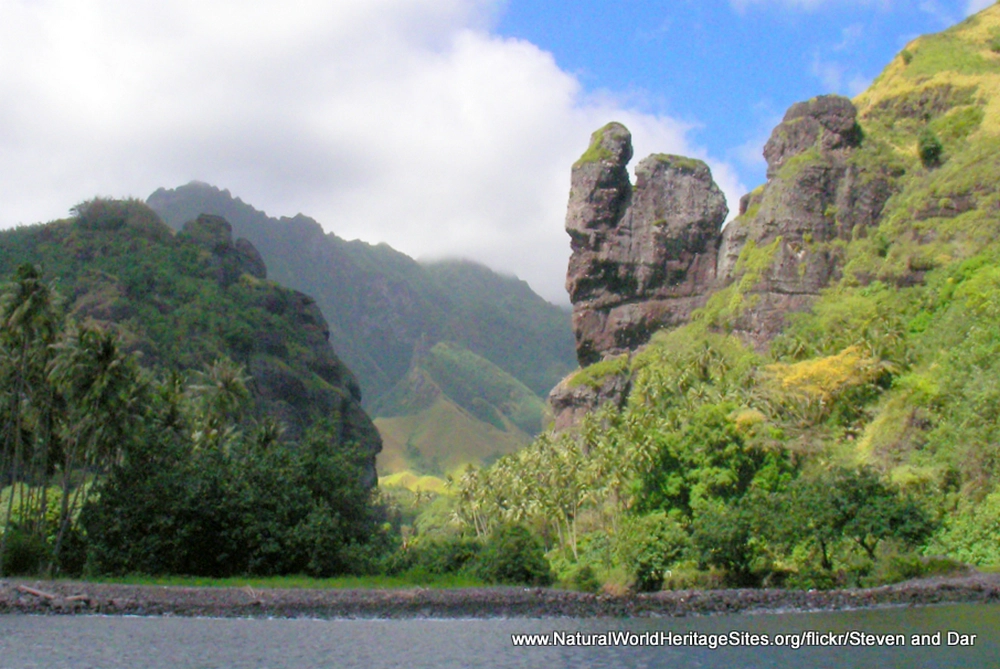
Slideshow Description: The slideshow ‘tells the story’ of Te Henua Enata – The Marquesas Islands with a portfolio of photos that illustrate the landscape features of the world heritage site. The following Flickr photographers and other sources are acknowledged with thanks for their contributions to this slideshow (as indicated in the watermarks of each photo): Ismaguell; Phillippe Reichert; Bob Jones; Stephen Degraaf; Steven and Dar; Keith O’Brien; rsnugent; Behan; Hugh Byrne; Yannck Daligault; Luis Mata and Ron Yeany.
Factfile
Website Category:
Area: 3,457 km2
Inscribed: 2024
Criteria:
- Outstanding natural beauty (vii);
- Ecological processes (ix);
- Natural habitat for biodiversity (x);
- Significant number of rare, endemic and/or endangered species (x)
- Cultural criteria (iii) and (vi)

