
EXPLORE Mount Kumgang with this slideshow, check the location map and get all the facts and information below.


For slideshow description see right or scroll down (mobile). Click to view slideshow
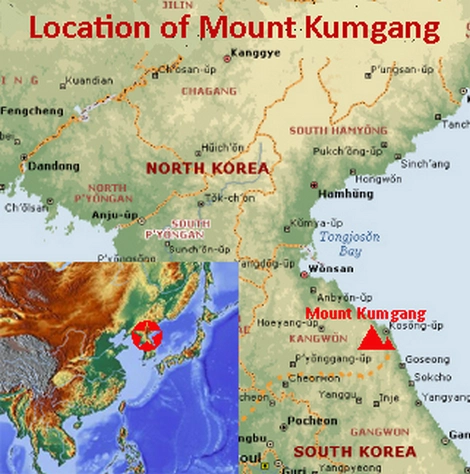
Location and Values: Mount Kumgang – Diamond Mountain from the Sea is located in the extreme south-east of the Democratic People’s Republic of Korea, near the de-militarised zone with South Korea. It is a mixed serial site, satisfying world heritage natural and cultural criteria, with two component parts. The largest part comprises the spectacular granite massif of Mount Kumgang itself (196 km2), while the smaller Samil Lagoon Area (2km2) is a scenically attractive lake naturally encircled by low forested mountains lying between the main mountain and the sea. Mount Kumgang is a place of exceptional natural beauty, renowned for its near-white granite peaks, deep valleys, waterfalls, and pristine ecosystems, rising to nearly 1,600 metres. The mountain’s spectacular scenery is enhanced through constantly changing weather patterns of mists, rain, sunshine and clouds. This sacred mountain is a key site of mountain Buddhism, with traditions dating back to the 5th century.
From a cultural perspective the landscape setting of steep granite peaks, rock formations, waterfalls and pools are integral to the long traditions of Buddhist pilgrimage, and the many famed literary and artistic representations of Mount Kumgang. Three temples remain active today. The site’s intangible cultural heritage is further reflected in the naming of key landscape features, poems and folk tales. Temples, pagodas, steles, stupas, sculptures and stone lanterns reflect the sequence of development of Korean mountain Buddhism over the centuries. Stone-carved calligraphy and historic trails lead to famed scenic viewpoints. Some of the cultural heritage attributes also provide evidence of the intermingling of Buddhism with Taoism and local spirituality, such as mountain gods, the Great Bear, and wild animals.
Conservation Status and Prospects. According to IUCN’s evaluation of the nomination file (2025) the natural systems, forests and waters of Mount Kumgang are in excellent condition due to low development pressure and long periods of strict protection. The legal regime protecting the site is very strong and strictly applied. Hunting, poaching, logging, grazing, farming and mining are all prohibited, as are all forms of building (except where necessary for management and the provision of essential visitor infrastructure). Mount Kumgang is reported to be relatively free of alien invasive species.
Overall, the site faces a low level of threats, the two most significant being future tourism; and a possible increase in natural hazards due to climate change. Tourism pressures have been very low in the recent past, but are expected to increase following the World Heritage listing. All visits are guided, and very strict prohibitions apply to visitor behaviour. For example, visitors are forbidden from swimming or even bathing their feet or faces in the natural pools to protect water quality. In terms of possible impacts from climate change it is noted that the site’s delicate natural rock formations, steep slopes and cultural features are susceptible to landslides, flooding, forest fires and other natural hazards.
The wider region around Mt. Kumgang is relatively undeveloped and the buffer zone has no reported industrial scale development or mining. Agriculture and pastoralism in the buffer zone are restricted to small scale, mostly non-mechanised practices (oxen drawn carts and ploughs, hand harvesting etc).
LINKS:
Google Earth
UNESCO Official Website
Birdlife IBA/KBA
Slideshow description
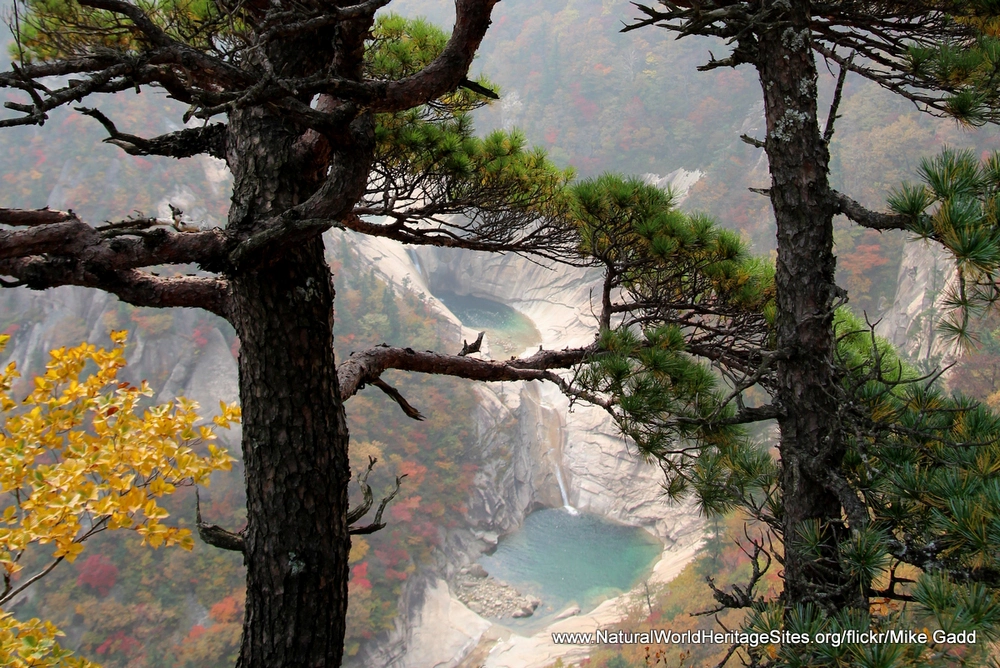
Slideshow Description: The slideshow ‘tells the story’ of Mount Kumgang with a portfolio of photos that illustrate some landscape features and cultural attributes of the site.
The following Flickr photographers and other sources are acknowledged with thanks for their contributions to this slideshow: Mike Gadd, Githaiga22, Smith family1, Sue Fleckney and the Korea National Heritage Preservation Agency/Ryu Tok In. Photo credits are provided in the watermarks of each image.
Factfile
Website Category:
Mountains;
Area: 198 km2
Inscribed: 2025
Criteria:
- Exceptional natural phenomenon (vii);
- Outstanding natural beauty (vii);
- Cultural tradition (iii)
