
EXPLORE the Hubei Shennongjia with this slideshow, check the location map and get all the facts and information below.


For slideshow description see right or scroll down (mobile). Click to view slideshow
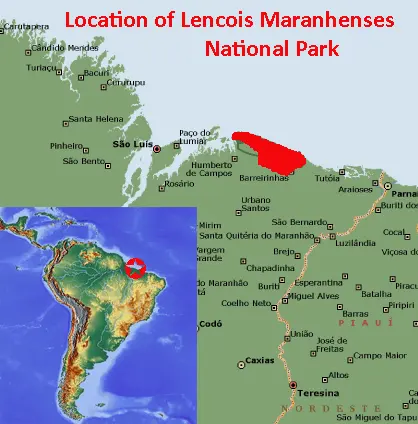
Location and Values: Lençóis Maranhenses National Park is located along 80km of sandy coast in northeastern Brazil. It encompasses an extraordinary landscape of white ‘barchan’ sand dunes in an ever-changing wind-blown configuration, interspersed with small seasonal lagoons which fill the troughs between dunes. The beds of these lagoons are coated with a layer of brown or green algae and cyanobacteria, contributing to the ever-changing scenery and variety of shapes and colours. The dune field is the largest in South America, forming winding chains up to 75 km long and stretching 20 km inland. The formation of this unique landscape over the millennia results from the interplay of ocean currents, wind and rainfall. Sand deposited by tides on the beach is picked up and transported by the wind, creating small dunes near the shoreline, while piling sand up to 30 m high on top of dunes from previous generations further inland. The high rainfall in this part of Brazil provides large volumes of water to create the colourful seasonal lagoons.
Conservation Status and Prospects. According to IUCN’s Conservation Outlook Assessment (2025) the conservation status of the Lençóis Maranhenses National Park is ‘good with some concerns’. The site itself is in an excellent state of conservation, due to its difficult access. However, there is an ongoing need to resolve local community concerns, especially the recognition of rights for about 4,000 people living within the site who practice agriculture, fishing and cattle keeping. There is also some concern over the development of illegal tourism infrastructure in areas bordering the site and associated plastic pollution. Potential threats from outside the site also include offshore oil exploration and the possibility of oil spills from shipping (such as occurred in 2019, affecting over 2,000 km of Brazil’s coast). Other concerns include (1) the possible impacts of offshore wind farms, (2) the potential for extreme climatic events linked to climate change.
LINKS:
Google Earth
UNESCO Official Website
IUCN Conservation Outlook
Slideshow description
Slideshow Description: The slideshow ‘tells the story’ of the Lençóis Maranhenses National Park with a portfolio of photos that illustrate the exceptional natural beauty of the dune fields and other landscape features of the park and its immediate vicinity. The slideshow begins with a series of photos showing the highest dunes and their associated lagoons at a time when they are fully filled and at their most photogenic. During the rainy season fresh water in the lagoons reflects the blue skies above, in stark contrast to the dazzling white sand of the dunes themselves. At drier times of the year the water depth in the lagoons is much reduced and many dry up completely, a cyclical process that creates a range of conditions, colours and scenery. Visitor access to the dunes is by 4×4 vehicle along the wide coastal strip. The final part of the slideshow illustrates parts of the park and its periphery where there are coastal lagoons, palm forests, mangroves and pioneer communities of coastal scrub, inhabited by bearded capuchin monkeys, scarlet ibis and other iconic wildlife. Outside the park, fishing communities take advantage of the abundant marine resources. Most of the photographs are taken by Peter Howard, with thanks for additional contributions from DMC Brasil and Matthieu Jolivet (as indicated in the watermarks of each photo).
Factfile
Website Category:
Marine & coastal;
Area: 1,566 km2
Inscribed: 2024
Criteria:
- Exceptional natural phenomenon (vii);
- Outstanding natural beauty (vii);
- Geological features (viii);

