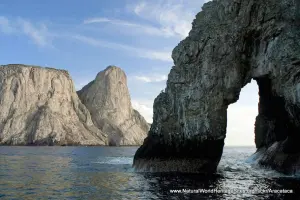
EXPLORE the Hubei Shennongjia with this slideshow, check the location map and get all the facts and information below.


For slideshow description see right or scroll down (mobile). Click to view slideshow
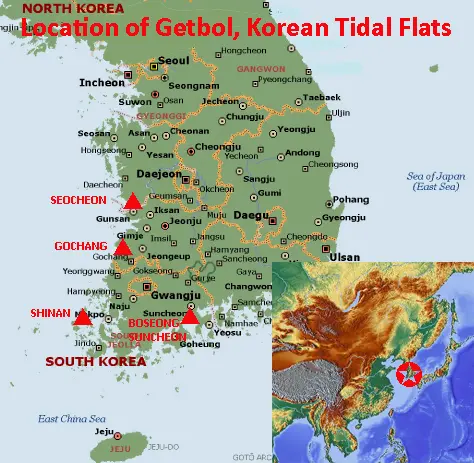
Location and Values: Getbol is the Korean term for the tidal mudflats that characterize the country’s western shore, bordering the Yellow Sea. Similar mudflats extend around most of the shores of the Yellow Sea between China and the Korean peninsula, and this serial site includes four small areas selected to represent the diversity of geo-physical and ecological conditions exhibited by these tidal flats. The four components are (from north to south) Seocheon (68 km2, representing an ‘estuarine’ type of Getbol), Gochang (55 km2, an ‘open embayed’ type), Shinan (110 km2, an ‘archipelago’ type), and Boseong-Suncheon (60 km2, a ‘semi-enclosed’ type).
The wider Yellow Sea (with China’s Bohai Gulf) is a vast shallow bay (455,000 km2, about the size of Germany, Netherlands and Belgium combined, or the US state of California). It takes its name from the colour of its waters, that receive sand and silt from the Yellow, Liao and Hai He rivers on the Chinese side of the bay and Korea’s Yalu River. These silt-laden waters are rich in nutrients and support a highly productive ecosystem of micro-organisms (diatoms, algae etc), macrobenthos (such as worms, molluscs and crabs) and salt-tolerant plants. These then provide food for many of the estimated 50 million migratory waterbirds that use the Yellow Sea mudflats as a stopover along the East Asian-Australasian Flyway (between nesting areas in eastern Asia as far north as Siberia and Alaska, and non-breeding areas as far south as Australasia). Other parts of the Yellow Sea are World Heritage listed under China’s ‘Migratory Bird Sanctuaries along the coast of Yellow Sea – Bohai Gulf of China’ site. Several globally threatened species of migratory birds use the flyway, including Spoon-billed Sandpiper; Far Eastern Curlew; Black-faced Spoonbill; Great Knot; Spotted Greenshank; Hooded Crane; Saunders’s Gull; and Chinese Egret.
Conservation Status and Prospects. According to IUCN’s Conservation Outlook Assessment (2025) the conservation status of the Getbol, Korean Tidal Flats is ‘good with some concerns’. The IUCN report
notes that the country’s coastal zones have been severely impacted by past reclamation projects with an overall decline of 65% of tidal flat area since the 1950s. However, the Tidal Flat Act of 2019 halts any further reclamation of tidal flats and actions under this legal framework have been progressively restoring affected tidal flats. Migratory bird monitoring programs have recorded a consistent rise in both the diversity and population of internationally protected species since the world heritage listing, although research suggests that a key constraint is the availability of high tide roost sites and upper shore feeding areas.
The livelihoods of many local communities depend on the harvest of marine resources, and shell-fish farming and other economic activities are widespread within the world heritage site. Any expansion of these activities could threaten the ecological integrity of the site. Other threats recognized in the IUCN report include (1) infrastructure development such as power transmission cables, (2) marine pollution and (3) the potential threat from invasive plant species such as Spartina sp.
LINKS:
Slideshow description
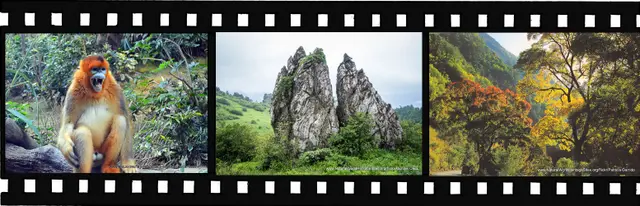
The slideshow ‘tells the story’ of the Getbol, Korean Tidal Flats with a portfolio of photos by Peter Howard and Bastian Bertzky. These illustrate the main features and species that are characteristic of the mudflats, including several species of crab, mud octopus and mudskipper fish. The mudflats are especially important as a feeding ground for waders and waterbirds on migration and a few species are illustrated. Most of the photos are from the Shinan and Boseong-Suncheon components of this serial site, where there are substantial visitor facilities, including raised boardwalks, bird hides and interpretative displays. The slideshow finishes with some photos of the traditional methods of farming and harvesting of sea food from the mudflats, as well as other economically important activities that impact the mudflat ecology such as offshore fishing, intensive aquaculture in areas bordering the mudflats and sluice gates for water management.
Factfile
Website Categories:
Marine & coastal;
Area: 1,284 km2
Inscribed: 2021
Criteria:
Natural habitat for biodiversity (x);
Significant number of rare, endemic and/or endangered species (x)