
EXPLORE the Hubei Shennongjia with this slideshow, check the location map and get all the facts and information below.


For slideshow description see right or scroll down (mobile). Click to view slideshow
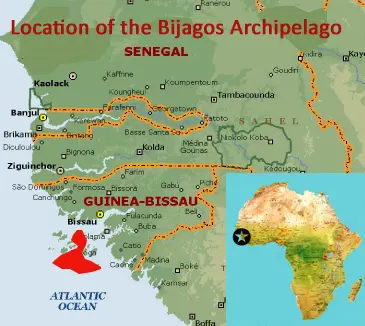
Location and Values: The Coastal and Marine Ecosystems of the Bijagós Archipelago are located in the shallow coastal waters of Guinea-Bissau in West Africa. The World Heritage Site covers about half the total area of intertidal and marine habitats in the archipelago, including three designated marine protected areas (João Vieira and Poilão Marine National Park, Orango Islands National Park, and the Community Marine Protected Area of the Urok Islands (Formosa, Nago, and Chediã)). The islands themselves and other marine areas within the archipelago are recognized as a buffer zone designed to mitigate external impacts on the World Heritage Site such as pollution, overfishing, and climate-related changes (these buffer zone areas are designated as a Biosphere Reserve).
The Bijagós Archipelago is a deltaic island system, formed by sedimentary inputs from the Geba and Corubal rivers which drain parts of the West African mainland, combined with coastal upwelling and tidal currents. The mangroves, mudflats, and intertidal zones are highly productive habitats supporting numerous migratory and resident species. There is an exceptional diversity and abundance of sea turtles, sharks, rays and other elasmobranch fish, marine mammals and over-wintering shorebirds. The area serves as the second most important over-wintering site for Palaearctic migratory waders along the East Atlantic Flyway (after Mauritania’s Banc d’Arguin), typically supporting around 300,000 birds. Many rare and threatened species occur, including leatherback and green turtles, manatee, Atlantic humpback dolphin and Timneh parrot. One of the most important nesting colonies of Green Turtle in the world is found on Poilão Island, and the site supports one of the rare populations of ‘marine’ hippo. Some of the islets serve as heronries, and support breeding colonies of ibises, gulls and terns.
Conservation Status and Prospects. According to IUCN’s evaluation of the 2025 nomination (and its evaluation of an earlier nomination in 2013) the conservation status of the Coastal and Marine Ecosystems of the Bijagós Archipelago has been considerably strengthened in recent years and is now supported by a strong legal framework and traditional practices. The Bijagó people, who inhabit the archipelago, have a longstanding tradition of sustainable management and resource use aligned with conservation. Traditional customs restrict access to certain areas, especially turtle nesting beaches and mangrove habitats.
The IUCN evaluation of a previous (2013) nomination identified fishing, including commercial fishing, forest exploitation, invasive species, shipping, offshore petroleum exploration and sea level rise as key threats to the area that was nominated (which included some of the islands). It is not clear that any of these threats have been significantly reduced in the wider area of the archipelago since that time, but the revised nomination excluded the islands, thereby eliminating concerns over forest exploitation and invasive species from consideration of the newly-configured nomination. IUCN’s 2025 evaluation concluded that none of the threats identified previously is likely to have a negative impact on ecological processes or wildlife of the re-configured site.
The nature of the site means that it is vulnerable to existing and potential threats originating beyond its boundaries. Its outstanding universal values are largely based on its role as a seasonal sanctuary for migratory birds and marine species which may be at risk elsewhere in the world. In general, migratory bird colonies have severely declined globally due to loss of habitats, so the populations of overwintering birds in the Bijagos Archipelago are clearly vulnerable to habitat losses at other sites in their summer breeding ranges and along the East Atlantic Flyway. Similarly, the green turtle nesting sites and populations of other wide-ranging marine species (such as sharks and rays) are clearly dependent on the suitability of marine habitats and protection from over-fishing and other threats more widely across the Atlantic.
The site is also dependent on the continuing sedimentary dynamics that sustains the active deltaic system. This may be impacted by changes in river and sediment flow from the West African interior, as well as the possible effects of climate change, sea level rise and changes in the existing ocean currents. The sediment and freshwater provision from the Geba and Corubal Rivers is dependent on watershed management as far afield as Guinea’s Fouta Djalon highlands and could be impacted by development activities such as dam construction or irrigation schemes within the catchments.
LINKS:
Slideshow description
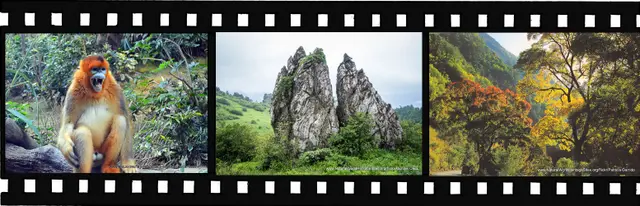
Slideshow of the Coastal and Marine Ecosystems of the Bijagós Archipelago: The slideshow features a portfolio of photographs showing the coastal landscapes, mangrove forests, beaches, wetlands and some of the typical wildlife and local culture. These are from a variety of sources including the World Heritage nomination file, the Orango Parque Hotel website and other contributors. Individual photo credits are provided in the watermarks of each photo.
Factfile
Website Categories:
Marine & coastal
Area: 3,941 km2
Inscribed: 2025
Criteria:
- Ecological processes (ix);
- Natural habitat for biodiversity (x);
- Significant number of rare, endemic and/or endangered species (x)
