
EXPLORE the Nyungwe National Park with this slideshow, check the location map and get all the facts and information below.


For slideshow description see right or scroll down (mobile). Click to view slideshow
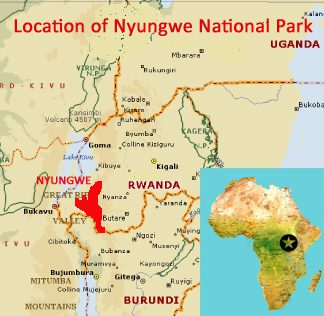
Location and Values: Nyungwe National Park is located on the eastern flank of the western (Albertine) branch of the Great Rift Valley, to the southeast of Lake Kivu. It is a mountainous region, mostly forested and ranging in altitude from about 1,500 to 3,000 m. This wide range of altitude and the relatively large size of the park contribute to its exceptional diversity of forest types and species. In addition to its extensive Afro-montane rainforests, the park covers some important high altitude wetlands, ericaceous thickets and moorlands and smaller areas of bamboo forest. The combination of habitats is exceptional and there are 1,441 species of vascular plants recorded, 14 species of primate and 371 species of birds. All taxonomic groups include significant numbers of species endemic to the small Albertine Rift region of central Africa, including 256 plants (18% of the park’s total) and 25-30 birds (7-8%). Notable amongst the many rare and endangered species are chimpanzee, l’hoest’s, Angolan colobus, owl-faced and golden monkeys, white-bellied pangolin, upland horseshoe bat and birds such as the Grauer’s swamp warbler, African grey parrot and Shelley’s crimsonwing. Altogether the park sustains populations of 12 species of globally threatened mammals and seven species of threatened birds.
Conservation Status and Prospects. According to IUCN’s Conservation Outlook Assessment (2025) the conservation status of Nyungwe National Park is ‘good with some concerns’. The park is managed by the international non-governmental organization, African Parks. The IUCN report indicates that the present low level of threats is addressed effectively inside and outside the park and the park benefits from the development of sustainable funding mechanisms and good relationships with local communities. It is, however, noteworthy that four of the park’s keystone species (elephant, buffalo, giant forest hog and leopard) have become locally extinct in recent years. The park is located close to the borders with the Democratic Republic of Congo and Burundi, an area of ongoing conflict. This has necessitated a significant presence of military personnel in the park to maintain security.
The IUCN assessment highlights three significant threats to Nyungwe National Park, namely (1) the existence of a major international road crossing the park (used by heavy trucks that may accidentally kill and disturb wildlife and serve as an internal barrier to the free movement of animals); (2) high levels of poverty amongst the densely populated neighbouring communities (which suffer significant levels of conflict with wildlife (through crop-raiding etc) and may be involved in hunting within the park); and (3) the potential for invasive alien plant species that are established in neighbouring areas to spread into the park. In addition to addressing these threats, continued vigilance is required to (1) control small scale artisanal mining for gold within the park and (2) minimize the risk of disease transmission between people, chimpanzees and other primates where close encounters are an important element of the visitor experience.
LINKS:
Slideshow description
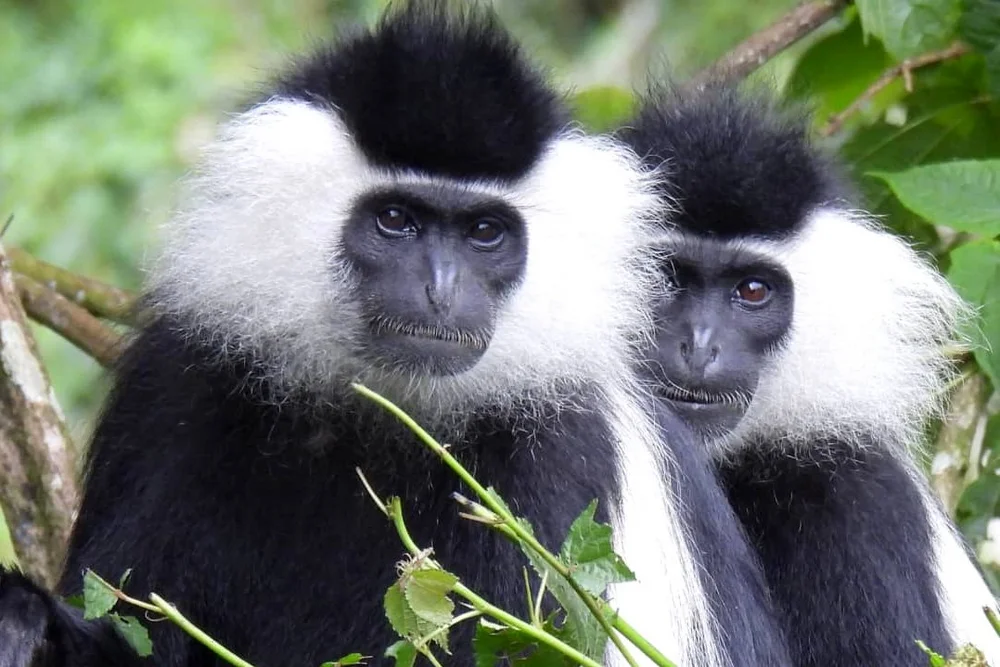
Slideshow of the Nyungwe National Park: The slideshow features a portfolio of photographs by Peter Howard and Nigel Dudley showing some of the main habitats, forest types and landscape features across the park. Visitor access is strictly limited to specific trails which must be followed in the company of a registered community guide. Self-guiding is not permitted, and visitors are not allowed to stop along the main road through the park. One of the highlights for many visitors is to see the forest from the heights of a canopy walkway, built near the park headquarters at Uwinka. Zip lines and ropeways are also being developed as visitor attractions. The slideshow includes photographs of some of the more conspicuous mammals and birds found in Nyungwe National park, including Angolan black and white colobus monkeys, scarlet-chested sunbird, handsome spurfowl, Hunter’s cisticola, l’Hoest’s monkey and olive baboon.
Factfile
Website Categories:
Tropical and sub-tropical forests;
Area: 1,020 km2
Inscribed: 2023
Criteria:
- Natural habitat for biodiversity (x);
- Significant number of rare, endemic and/or endangered species (x)

