
EXPLORE Madagascar’s Andrefana Dry Forests with this slideshow, check the location map and get all the facts and information below.


For slideshow description see right or scroll down (mobile). Click to view slideshow
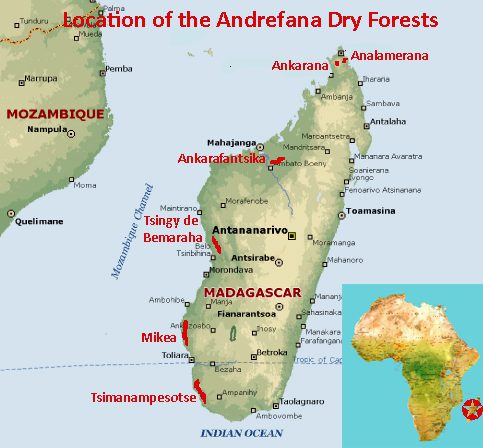
Location and Values: The six protected areas of the Andrefana Dry Forests are located along the dry western flank of Madagascar, from the extreme north of the island (the Special Reserves of Ankarana and Analamerana), to its far south (Tsimanampesotse National Park), with Ankarafantsika, Tsingy de Bemaraha and Mikea National Parks at intermediate latitudes. Collectively, these six protected areas cover almost the full range of ecological and evolutionary variation within the western forests of Madagascar, including western dry forests and southwestern spiny forest-thicket. They contain a spectacular array of endemic and threatened biodiversity, including baobabs, flame trees (Delonix), as well as unique evolutionary lineages such as the Mesites, an order of (almost flightless) birds which is 54 million years old. The addition of five protected areas to the original Tsingy de Bemaraha Strict Nature Reserve world heritage listing in 2023 created a serial site with an additional 1,000 endemic species and sub-species of plants, 156 endemic reptiles, 57 endemic mammals and 34 endemic amphibians.
The specific attributes which qualify the Andrefana Dry Forests for world heritage status, as demonstrated by the Tsingy de Bemaraha National Park, can be summarised as follows:
Unique and spectacular geomorphological features. The 250 km long Bemaraha Plateau is a unique, spectacular landscape of outstanding beauty. Its most prominent feature is an extensive ‘stone forest’ of sharp limestone pinnacles, up to 100 metres high, with networks of deep crevasses, underground rivers and caves below.
Rich endemic flora. The vegetation is classified as ‘western dry forest’, one of the most threatened biomes in Madagascar. The flora of the dry forest is typically deciduous, with dominant trees of the genera Dalbergia, Commiphora and Hildegardia. Meanwhile, the vegetation on the exposed rocks comprises a xerophytic scrub containing succulents, and the canyons enjoy moister conditions which supports a dense sub-humid forest. At least 457 plant species representing 81 families have been recorded. Although the number of endemic plants within the reserve is unknown, 84% of Madagascar’s vascular plants are endemic to the island. Most of the reserve’s plants are found only in the drier parts of Madagascar and therefore likely to have very limited worldwide distributions. Internationally-recognised threatened species of tree include the ‘Endangered’ Khaya madagascariensis, Phylloxylon perrieri, and Dalbergia humbertii, as well as the ‘Vulnerable’ Dalbergia baronii and Delonix regia.
Rare and endemic mammals. At least 42 species of mammal have been recorded in the Tsingy de Bemaraha National Park alone, of which 35 are endemic to Madagascar. Eleven species of lemur occur, including the ‘Vulnerable’ Decken’s sifaka and the recently described, locally endemic Bemaraha woolly lemur (classified as ‘Endangered’). Eleven species of small mammal are known from the reserve, including three that are locally endemic to a small area of north-western Madagascar: Grandidier’s shrew tenrec (described in 2009), Tsingy tuft-tailed rat (described in 2001) and the ‘Endangered’ lowland red-forest rat. Two species of the endemic Malagasy civet and mongoose family (Eupleridae) have been recorded, as well as 18 species of bat.
Rare and endemic birds. Although the number of bird species recorded in the Tsingy de Bemaraha National Park is relatively small (94 species), a remarkably high proportion of them are found only in Madagascar, including species of the endemic family of Malagasy warblers (Bernieridae), the near endemic families of vangas (Vangidae) and the cuckoo roller (Leptosomatidae), as well as the endemic couas (subfamily Couinae) and asities (subfamily Philepittinae). Threatened species include the ‘Critically Endangered’ Madagascan fish eagle; the ‘Endangered’ Malagasy pond heron, Madagascar heron, Madagascar teal and Madagascar grebe (all of which are occasional visitors to the Manambolo river in the south of the park) and the ‘Vulnerable’ Malagasy harrier. Madagascar’s newest bird species, the rail Mentocrex beankaensis, was described in 2011 and is only known from the Bemaraha and Beanka massifs.
Rare and endemic reptiles and amphibians. The Andrefana Dry Forests support an exceptionally rich fauna of reptiles and amphibians, many of which are threatened. At least 63 reptile species have been recorded in the Tsingy de Bemaraha National Park alone, of which 58 are endemic to Madagascar and 17 (27%) appear to be endemic to the Bemaraha massif. Nineteen species of amphibian are also known, representing the highest total for any site in the dry regions of Madagascar. Six of these species (some not yet described) appear to be endemic to Bemaraha. Threatened species of reptile include the ‘Critically Endangered’ Madagascar big-headed turtle; the ‘Vulnerable’ big-headed gecko, leaf-tailed gecko, dwarf chameleon, Ground Gecko (Paroedura tanjaka), Nicosia’s chameleon and the arboreal snake, Phisalixella variabilis; as well as four species classified as ‘Vulnerable’ Amphiglossus splendidus, Madascincus intermedius, Uroplatus ebenaui and Lycodryas citrinus. New species are being ‘discovered’ quite frequently from each of the Andrefana Dry Forests, while others await formal scientific description.
CONSERVATION STATUS AND PROSPECTS: According to IUCN’s Conservation Outlook Assessment (2025) the conservation status of the Andrefana Dry Forests is ‘good with some concerns’. Overall, the strategic approach to conserving biodiversity and enhancing the value of natural resources in the Andrefana Dry Forests is adequate and appropriate. Threats are diminishing and the peripheral areas of the protected areas are increasingly valued by local communities with the technical and financial support of Madagascar National Parks. Nevertheless, the following issues represent specific threats to the ecology, conservation and values of some areas within the Andrefana Dry Forests world heritage site.
Subsistence hunting. A limited amount of subsistence hunting takes place, particularly in the vicinity of villages adjacent to the protected areas, targeting various species of lemur and other threatened species. For example, the critically endangered Madagascar big-headed turtle is hunted in the Tsingy de Bemaraha’s Manambolo River . Overall, hunting pressure is probably not high enough to have a significant impact on the populations of target species.
Cattle Grazing. Cattle are brought into the more accessible parts of some of the protected areas for grazing and may affect natural regeneration of forest in some areas.
Incidence of Fire. Fires are set in June-October, (before the seasonal rains), to stimulate the growth of new grass for cattle grazing, and allow easy access for local people making subsistence use of minor forest produce. This may affect regeneration of some vulnerable (forest) species of plants, and kill animals caught up in the fires, especially slow-moving reptiles and amphibians.
Agricultural encroachment. There is some indication of limited, highly localised agricultural encroachment involving slash-and-burn cultivation. This is not thought to be widespread, but may increase as land-use pressures across Madagascar intensify.
Charcoal production. The use of charcoal for cooking is widespread and its production as an economic activity in rural areas has devastating environmental impacts. Charcoal production is reported from some of the Andrefana Dry Forest areas.
Exploitation of minor forest produce. There is considerable pressure from local communities for honey and certain plant tubers collected from the protected areas. The impact of this is limited by the difficulty of accessing many of the areas.
Invasive Alien Species. No problems related to invasive alien species are reported, although the introduced tree Ziziphus sp. has become established elsewhere in the dry forests region, where it forms thick, single-species stands replacing the natural vegetation. Fortunately it does not appear to invade intact forest, and has not yet been recorded in the national parks and special reserves that make up the world heritage site.
International trade in reptiles as pets. Some reptiles are collected for the international pet trade, particularly specimens of the remarkable leaf-tailed gecko (Uroplatus henkeli) and the highly sought-after dwarf chameleon (Brookesia perarmata). The extent of collection is not known, but has probably reduced in recent years, especially since the dwarf chameleon was listed under Appendix I of the Convention on International Trade in Endangered Species (CITES) in 2002.
Tourism. The number of visitors is limited by the reserve’s difficult access, and their impact is highly localised and superficial.
Settlement by immigrants. While the indigenous local communities tend to support conservation of the protected areas (partly because they hold important cultural heritage values for them), the region is becoming increasingly settled by immigrants from other parts of Madagascar who don’t share those values and may be more inclined to over-exploit natural products from within the protected areas and their vicinity.
Climate change. The potential impacts of climate change are unknown, but it clearly represents a significant long-term threat to the area’s species and ecology. The Bemaraha Plateau has served as a ‘refugium’ for plants and animals during previous periods of climate change and may be more ecologically resilient than less diverse parts of western Madagascar’s dry forest zone.
LINKS:
Google Earth
UNESCO Official Website
Slideshow description
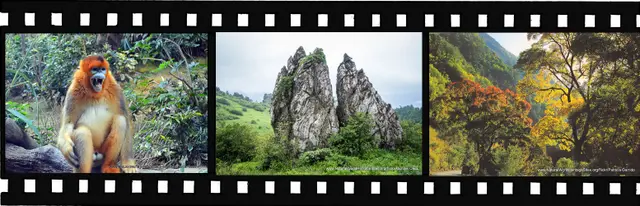
Slideshow Description: The slideshow ‘tells the story’ of the Andrefana Dry Forests with a portfolio of photos from the Tsingy De Bemaraha National Park (formerly designated as a Strict Nature Reserve). This area was inscribed on the World Heritage List in 1990, before the addition of five further areas in 2023 creating the present serial site. The Tsingy De Bemaraha is representative of the wider Andrefana Dry Forests and the slideshow illustrates the spectacular karst landscape features of this ‘stone forest’ together with the typical dry forest habitats, endemic plants and animals, lemurs, chameleons and other threatened species, conservation management issues, local community livelihoods and some of the visitor facilities and typical experiences.
Factfile
Website Categories:
Tropical & sub-tropical savannas & woodlands;
Area: 7,343 km2
Inscribed: 1990 (extended 2023)
Criteria:
- Exceptional natural phenomenon (vii);
- Outstanding natural beauty (vii);
- Ecological processes (ix);
- Natural habitat for biodiversity (x);
- Significant number of rare, endemic and/or endangered species (x)

