
EXPLORE The Flow Country with this slideshow, check the location map and get all the facts and information below.


For slideshow description see right or scroll down (mobile). Click to view slideshow
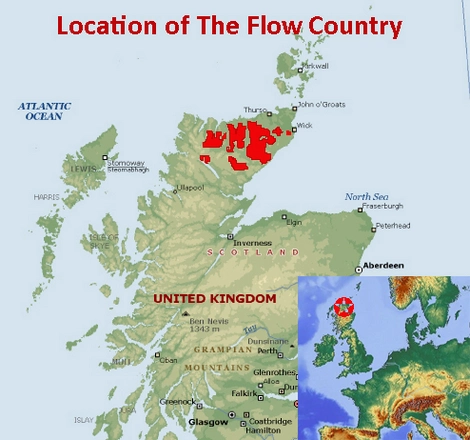
Location and Values: The Flow Country is located in the far north of Scotland and considered to be the most outstanding example of a blanket bog ecosystem in the world. A blanket bog is a rare type of peatland ecosystem formed in cool, wet and oceanic climates where high rainfall leads to waterlogged acidic soil (pH 4.8-5.6) that slows plant decay. It covers large expanses of land like a blanket, and (unlike ‘raised bogs’ which form in basins) covers flat, undulating and sloping ground. Scotland has about 15% of the world’s blanket bog and The Flow Country World Heritage Site protects about a third of that total. The Flow Country blanket bog and its intricate network of pools, hummocks and ridges stretches across much of northern Scotland and displays a remarkable range of features resulting from the climatic, altitudinal, geological and geomorphological gradients found across the region.
Blanket bogs (and other types of peatlands) play an important role in storing carbon, and ongoing peat-forming ecological processes continue to sequester carbon on a very large scale in The Flow Country. The underlying peat in this area has been accumulating for the past 9,000 years and is more than eight metres thick in some places. It contains an estimated 400 million tons of carbon. Some areas have been altered by past drainage and conifer plantation development so the boundaries of The Flow Country world heritage site are designed to exclude areas that are significantly altered by such developments, resulting in a serial site of seven components with somewhat convoluted boundaries.
The Flow Country blanket bog has between 29 and 34 peat forming species of Sphagnum moss, which are themselves home to complex assemblages of unique microorganisms adapted to survive in the low oxygen, cold temperature, acidic and oligotrophic conditions of bog systems. While Sphagnum mosses are the principal component of the vegetation, heathers, cotton grasses and insectivorous sundews are also important, adding to the area’s biodiversity values. The blanket bog ecosystem provides refuge for many breeding bird species and The Flow Country area is designated as an Important Bird Area on account of its significant populations of Wood Sandpiper, Greylag Goose, Short-eared Owl, Red-throated Loon, Golden Eagle, Peregrine Falcon, Hen Harrier, Arctic Loon, Merlin, Dunlin, and Golden Plover.
The blanket bog provides a highly significant record of its formation, preserved as pollen and plant fossils, and telling a story of its past flora, fauna, palaeo-ecology and human influence. This is important for the understanding of the future evolution of this and other blanket bogs globally and the processes of carbon sequestration in blanket bog formation.
Conservation Status and Prospects. According to IUCN’s Conservation Outlook Assessment (2025) the conservation status of The Flow Country is ‘good’. As noted above, parts of the extensive blanket bog landscape have been impacted by past drainage and conifer plantation development, so the boundaries of the serial site have been designed to exclude such areas. Significant efforts are now being made to restore the natural blanket bog ecosystem by removing tree plantations and filling drainage channels at a landscape scale. The results are impressive and some of the more advanced restoration areas are sufficiently natural to satisfy the World Heritage requirements for ecological integrity and have been incorporated into the World Heritage Site. There is scope for extension of the World Heritage Site in future as ongoing restoration of adjacent degraded areas progresses.
Local land-use threats to The Flow Country are low, given the low human population and inaccessibility of the protected bog areas. In future climate change may disrupt the hydrological cycle and lead to drying of the bogs and reduced peat accumulation. The development of wind turbines also poses a longer-term threat as the associated infrastructure of roads, turbines and underground cables may decrease the hydrological connectivity across the site. Many wind turbines have been built in the area and many more are planned.
LINKS:
Slideshow description
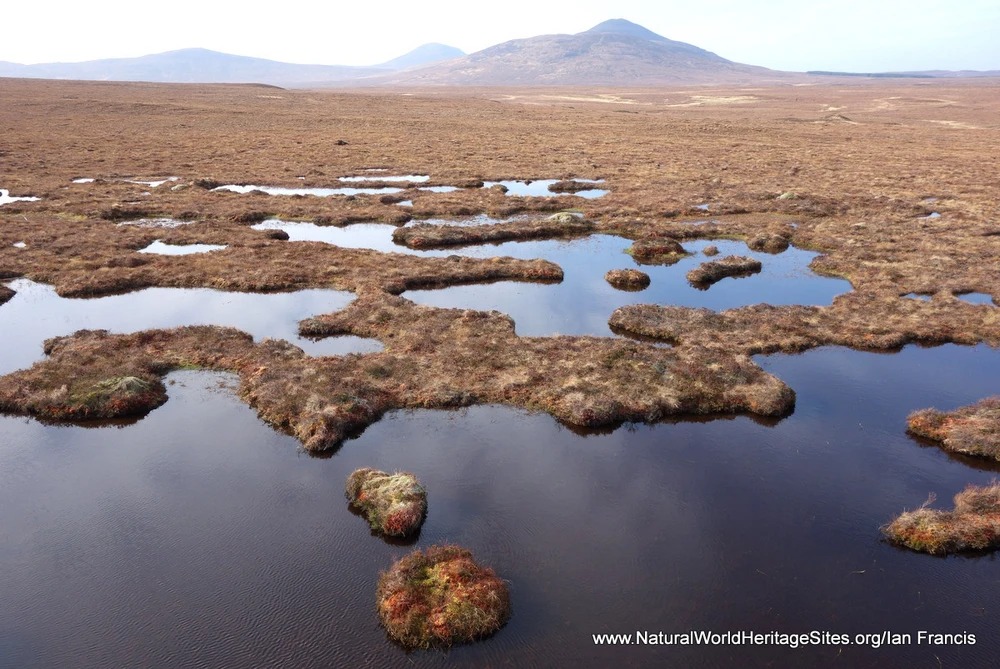
Slideshow Description: The slideshow ‘tells the story’ of The Flow Country with a portfolio of photos that illustrate the landscape features and typical species of the blanket bog ecosystem. The most accessible part of the site is the Forsinard Flows National Nature Reserve, where there is a viewing tower and boardwalk which traverses an area of typical blanket bog. The slideshow includes photos that illustrate the typical species, including a variety of sphagnum mosses, heathers, cotton grasses and insectivorous sundew plants. Some of the typical bird species include redshank, golden plover, curlew, scoter and lapwing. The Royal Society for the Protection of Birds (RSPB) manages the National Nature Reserve and has a visitor centre in the old railway station building at Forsinard (just outside the boundaries of the World Heritage Site). From here there are far-reaching views across parts of the wider landscape where ecosystem restoration work is underway. Ian Francis, Jane Wilson and Simon Howarth are thanked for use of their photos in this slideshow.
Factfile
Website Categories:
Lakes, freshwater wetlands & glaciers;
Temperate grasslands, steppes, shrub-lands & tundra
Area: 1,870 km2
Inscribed: 2024
Criteria:
- Ecological processes (ix);

