
EXPLORE ‘Uruq Bani Ma’arid with this slideshow, check the location map and get all the facts and information below.


For slideshow description see right or scroll down (mobile). Click to view slideshow
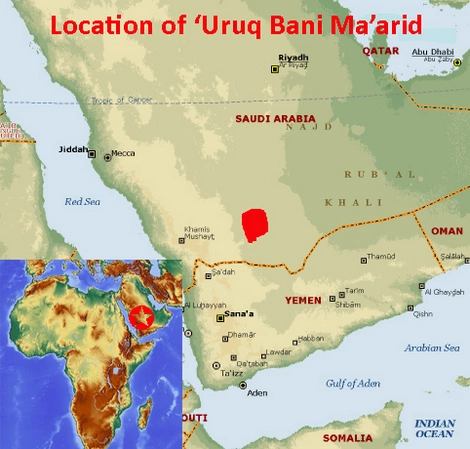
Location and Values: ‘Uruq Bani Ma’arid is a vast area of hyper-arid desert located on the western edge of Saudi Arabia’s ‘Empty Quarter’ or Ar-Rub’ al-Khali. This is the largest continuous sand sea on Earth and one of the Earth’s most spectacular desert landscapes with a wide variety of wildlife habitats. The area of the world heritage site supports greater biological diversity than any other part of the Ar-Rub’ al-Khali and features one of the world’s largest longitudinal sand dune systems. The dune system overlies a dissected limestone plateau with vegetated wadis, gravel plains, and inter-dune corridors, with a steep escarpment punctuating its western edge. The variety of interacting natural habitats and continuous changes in dune formations driven by wind creates an ecological network of patterns and processes providing for the conservation of globally important plant and animal species. ‘Uruq Bani Ma’arid is the last place where Arabian Oryx were observed in the wild, and it is now the focus of an intensive reintroduction program for Arabian Oryx and other threatened species, such as the Arabian Sand Gazelle, and Arabian Mountain Gazelle.
Conservation Status and Prospects. According to IUCN’s Conservation Outlook Assessment (2025) the conservation status of the ‘Uruq Bani Ma’arid is ‘good’. Uruq Bani Ma’arid remains one of the best preserved desert ecosystems on the World Heritage List, with limited current threats. The reintroduction of Arabian Oryx, Sand Gazelle and Mountain Gazelle has been very successful and protection efforts have enabled populations to increase naturally to over 300 Arabian Oryx and around 1,000 gazelles within the site (according to reports of the most recent drone census provided to Peter Howard in January 2026). However, the biodiversity and ecological interactions are fragile and could suffer from impacts, particularly from camel grazing and climate change. Other current threats are limited in magnitude and scope (illegal hunting, ecotourism and a cement factory). Ecotourism is expected to significantly increase from its current level (there were approximately 1,000 visitors in 2025, mostly international), but this is not likely to have significant impacts as visitor access is very limited, private vehicles are not allowed and all visitors are escorted into the area by National Centre for Wildlife staff.
LINKS:
Slideshow description
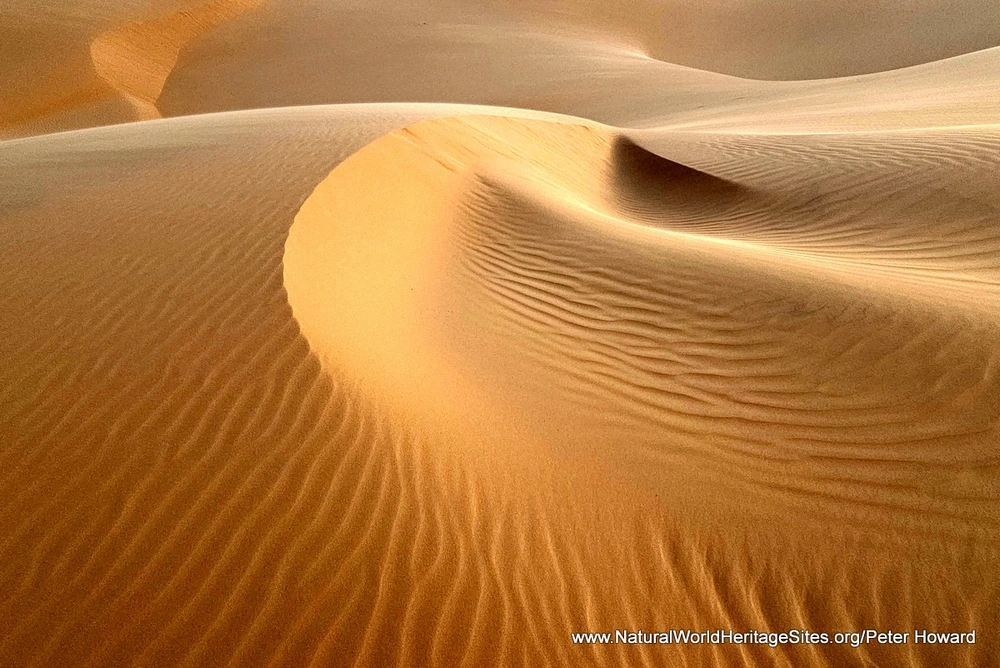
Slideshow Description: The slideshow ‘tells the story’ of ‘Uruq Bani Ma’arid with a portfolio of photos by Peter Howard from a two-day visit in January 2026. This visit was hosted most generously by the National Centre for Wildlife and involved four excursions into different areas of the two designated tourism zones. There are no roads or developed tracks into the site (beyond the main ranger station) so these excursions followed loosely defined ‘routes’ over the gravel plains, wadis, dunes and limestone pavements, with some spectacular views (and highly skilled driving!) from some high dune crests and the escarpment edge. The photos are arranged in chronological order, starting with the ‘Arabian Oryx Trail’ (which skirts along the top of the escarpment at the outer edge of the main dune fields) followed by an afternoon excursion onto some of the higher dunes along the ‘Ar-Rub al-Khali path’. On these excursions a couple of distant sightings of fast-running gazelles were made, and some recent foot prints of oryx encountered on a dune crest (before they were covered by wind-blown sand). Photos of some typical animals of the area (from other sources) are used for illustrative purposes, but it is worth noting that wildlife encounters are generally not part of the visitor experience. Visitors would be lucky to see any of the illustrated species – Houbara bustard, Arabian Sand gazelle, Mountain Gazelle, Arabian Oryx, Spiny-tailed lizard and Sand Cat.
The second part of the slideshow covers a longer excursion onto the top of the escarpment in the Al-Faw area, passing through some sand-filled wadis and across the bare limestone pavement, with far-reaching views from the top of the plateau. The wadis are bounded by shallow cliffs and a small cave provides cool sanctuary for bats, birds (and visitors!). The final part of the slideshow includes photos of spectacular sand formations in the warm evening light around sunset (from the crest of the ‘outermost’ dunes, accessed on foot near the main ranger station).
Factfile
Website Category:
Area: 12,765 km2
Inscribed: 2023
Criteria:
- Exceptional natural phenomenon (vii);
- Outstanding natural beauty (vii);
- Ecological processes (ix);

