
EXPLORE the Tugay forests of the Tigrovaya Balka Nature Reserve with this slideshow, check the location map and get all the facts and information below.


For slideshow description see right or scroll down (mobile). Click to view slideshow
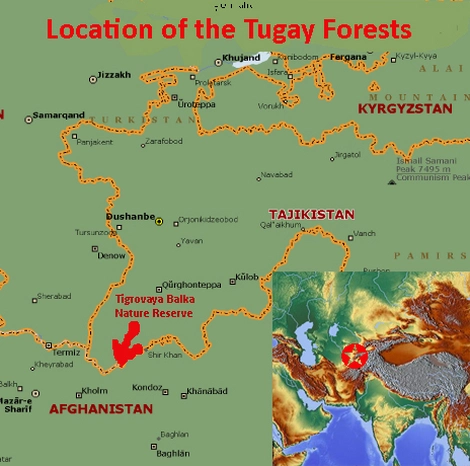
Location and Values:The Tugay Forests of the Tigrovaya Balka Nature Reserve lie on the floodplain and interfluve of the Vakhsh and Panj rivers in a semi-desert area of southwestern Tajikistan. The Tugay forests occupy about half the area of the reserve and represent the largest and most intact example of Asiatic poplar tugay forest surviving anywhere in the world. Tugay is a form of riparian forest associated with rivers and floodplains in arid climates across central Asia. In these arid regions the forest is largely dependent on floods and groundwater originating in upstream catchments (rather than direct rainfall). This type of forest has disappeared or become fragmented over much of its former range due to dam construction, tree cutting, grazing, and agriculture so protection of this habitat in the Tigrovaya Balka Nature Reserve is especially critical. In addition to the extensive riparian tugay ecosystems, floodplain terraces and old oxbow wetlands, other habitats in the reserve include the Kashka-Kum desert and low (1,000 – 1,200m) Hodja-Kaziyon mountains with their associated low-grass semi-savannas.
The World Heritage listing of the Tigrovaya Balka Nature Reserve recognizes the significant ongoing ecological and biological processes taking place in the evolution and development of the desert-steppe-tugay margins and their characteristic plant and animal communities. The reserve’s forests, sandy and saline semi-deserts, piedmont semi-savannas, and various wetlands are constantly adapting to changes in the hydrological regime and ecological conditions of the area. The tugay ecosystem itself is characterized by trees and shrubs such as the Asiatic Poplar, Oleaster and Tamarix, as well as small reed-filled wetlands. These support populations of Bactrian Deer, Goitered Gazelle, Striped Hyena, Gray Monitor, Tajik Black-and-gold Pheasant, and many waterfowl.
Conservation Status and Prospects. According to IUCN’s Conservation Outlook Assessment (2025) the conservation status of the Tugay forests of the Tigrovaya Balka Nature Reserve is of ‘significant concern’. The IUCN report highlights the most serious threat, with long-lasting impact, of the altered hydrological regime of the Vakhsh River due to the construction of a ‘cascade’ of eight dams and water offtake for irrigation. Previously, the tugay ecosystem in the lower part of the valley would be flooded in summer, driving an important ecosystem process of tugay regeneration, modifying and sustaining habitats through erosion and sediment inflow, controlling salinization, replenishing groundwater reserves and flushing out accumulated organic matter. This dynamic process no longer functions and the Tugay forests are now supported by channeled surface water and underground flows which may be insufficient for their continued survival. About a third of the catchment runoff into the Vakhsh river is now used upstream of the site for irrigation and a fifth of the river flow in the lower reaches is from waste water, which leads to an increase in mineralization and pollution of waters in the reserve.
The Panj river system is still relatively natural and unaffected by upstream dams, irrigation and other developments. However, the Tugay riparian woodlands associated with the lower Panj floodplains are of limited size, and much of the floodplain and catchment lies in Afghanistan. The Panj and Vakhsh rivers continue to be important sources of water for massive Soviet-era irrigation schemes downstream along the Amu Darya river in Turkmenistan and Uzbekistan. Over 96% of the water in the region is used for cotton production and other agriculture, and the Amu Darya river no longer flows regularly into the Aral Sea resulting in its drying out. The survival of the Tugay Forests and much of the region’s economic prosperity will continue to depend on appropriate management of water within the cascade of dams and wider catchment, and the ability to provide periodic artificial floods and other ‘environmental flows’.
LINKS:
Slideshow description
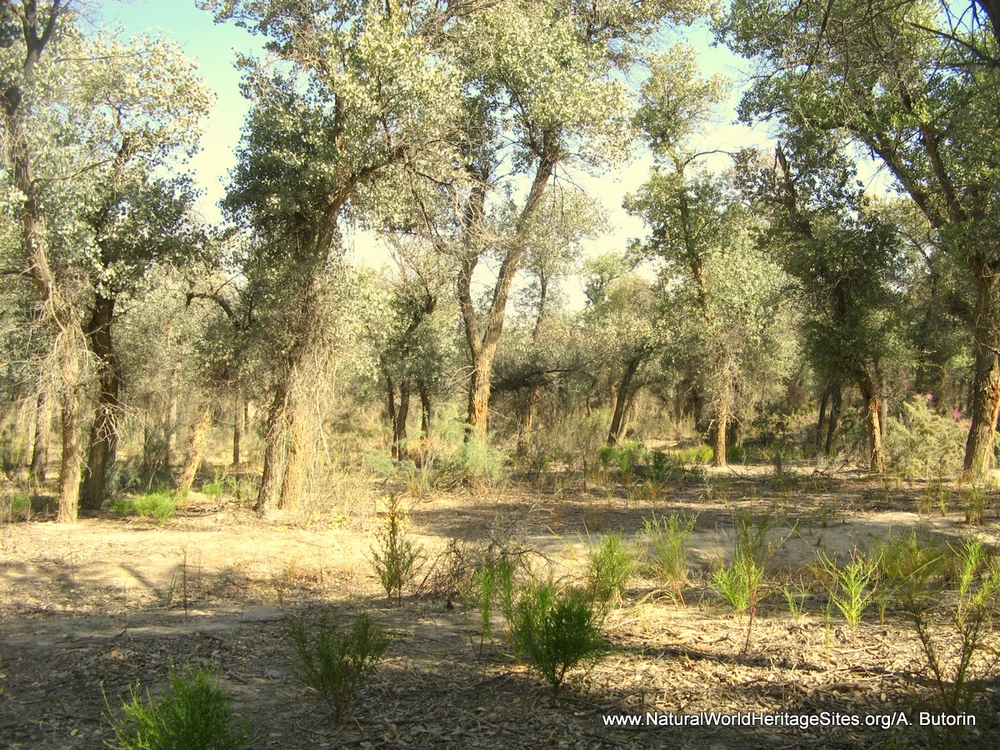
Slideshow Description: The short slideshows illustrates some of the landscape features of the Tugay forests of the Tigrovaya Balka Nature Reserve with photos from the World Heritage Nomination Dossier (and UNESCO website), with thanks to A. Butorin and F. Rakhimov. Photo credits are provided in the watermarks of each image.
Factfile
Website Categories:
Lakes, freshwater wetlands & glaciers;
Area: 498 km2
Inscribed: 2023
Criteria:
- Ecological processes (ix);

