
EXPLORE the Evaporitic Karst and Caves of Northern Apennines with this slideshow, check the location map and get all the facts and information below.
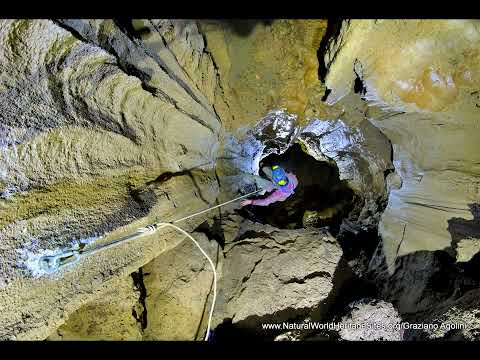

For slideshow description see right or scroll down (mobile). Click to view slideshow
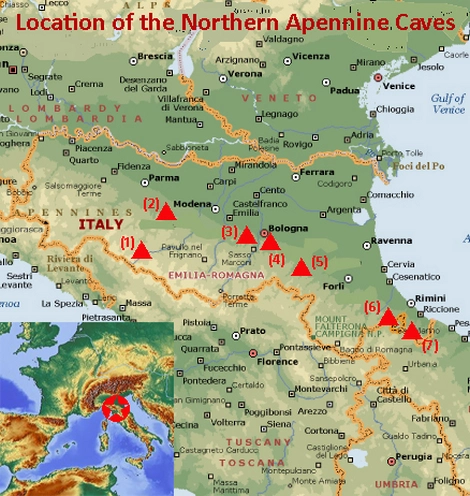
Location and Values: There are nine separate components to the Evaporitic Karst and Caves of the Northern Apennines serial site, spread along the foothills of the Apennine Mountains between the area around San Marino in the southeast and Reggio Emilia in the northwest, a distance of about 200 km. Most of the component parts are quite small (typically 1-3 km2), although the Vena del Gesso Romagnola (near Bologna) extends to 10 km2 and the Alta Valle Secchia (in the mountains southwest of Reggio Emilia) covers 16 km2.
Evaporitic karst is a special kind of landscape derived from gypsum and anhydrite rocks. There are many other karst landscapes and caves on the World Heritage List, all of them derived from sedimentary carbonate rocks (such as limestone and dolostone) laid down through the accumulation of shells and other solid particles in ancient seas. Evaporitic karst is different because it is derived from chemical sedimentary rocks that originated through the concentration and crystallization of dissolved minerals from ancient seas and saline lakes as their waters evaporated. These chemical sedimentary deposits are formed in arid environments where evaporation exceeds water inflow. Once formed, they remain relatively soft and more easily dissolved by rain, rivers and flowing water than carbonate rocks. As a result, evaporitic karst landscapes develop more rapidly and in characteristic ways, quite different from the more ‘typical’ landscapes and caves found across the world in limestone beds (which are very well represented by other sites on the World Heritage List).
The evaporitic rocks of the northern Apennines were deposited in two distinct geological periods: during the breakup of the supercontinent Pangea (c. 200 million years ago), and during a period when the Mediterranean Sea largely evaporated (c. 6 million years ago). Much later (i.e. over the last 500,000 years) the karst landscape and cave systems developed in these two ancient formations under wetter climatic conditions. The component parts of the Evaporitic Karst and Caves of the Northern Apennines site provide examples of the mineralogical evolution of gypsum, including its transformation into anhydrite and alabaster, with many speleothems and minerals, reflecting complex relationships between rocks, hydrogeology and climate.
The site has about 900 caves with a combined length of over 100 km, including some of the largest, deepest and most complex of their type. It also includes the evaporitic cave with the largest vertical drop in the world, the world’s largest surface water-formed karst cave and the largest karst salt spring in Europe. Several of the caves are open to the public on guided tours, including the Onferno Caves (at Gemmano), the Grotta dela Spipola (Gessi Bolognesi Park, near Bologna) and the Grotta del Re Tiberio (in the Vena del Gesso Romagnola park, near Bologna).
The above-ground landscape features are generally not as large and impressive as other more typical karst areas on the World Heritage List, but they nevertheless represent an interesting (if rather specialized) geological phenomenon.
For an excellent educational video about the Evaporitic Karst and Caves of the Northern Apennines visit: https://www.youtube.com/watch?v=s6rLY-eUgDc
Conservation Status and Prospects. According to IUCN’s Conservation Outlook Assessment (2025) the conservation status of the Evaporitic Karst and Caves of Northern Apennines is ‘good with some concerns’. The concerns relate to the lack of legal protection for some components of the site, and a complex management system that is inconsistent between areas. In addition, there are concerns about possible pollution and contamination of waters flowing through the site which could impact the mineral processes and cave-dwelling life.
LINKS:
Slideshow description
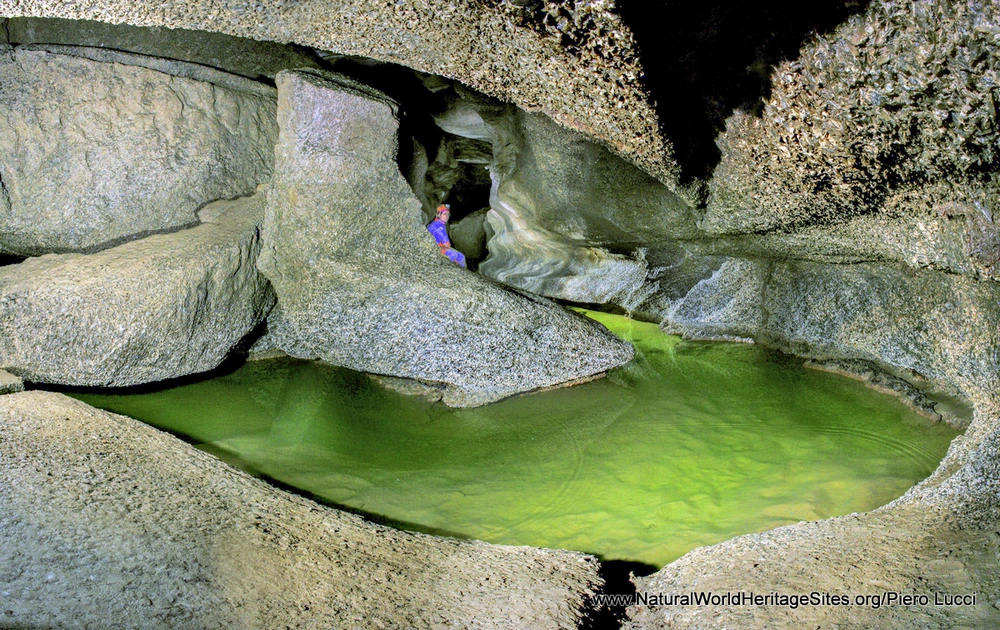
Slideshow Description: The short slideshow illustrates some of the underground features of the Evaporitic Karst and Caves of Northern Apennines with photos from the World Heritage Nomination Dossier (and UNESCO website), with thanks to Graziano Agolini, Vena del Gesso Park, Piero Lucci, and Hendrix Artoli. Photo credits are provided in the watermarks of each image.
Factfile
Website Category:
Area: 37 km2
Inscribed: 2023
Criteria:
- Geological features (viii);

