
EXPLORE the Cold Winter Deserts of Turan with this slideshow, check the location map and get all the facts and information below.


For slideshow description see right or scroll down (mobile). Click to view slideshow
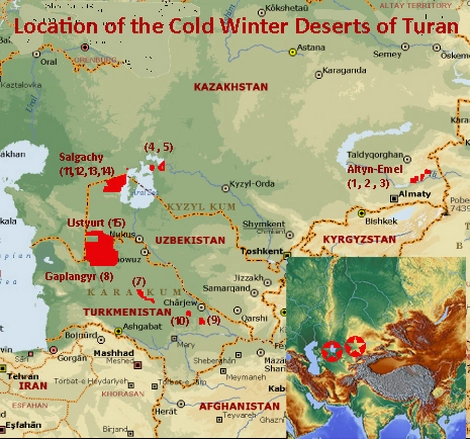
Location and Values: The Cold Winter Deserts of Turan is a vast transnational serial site with 14 component parts distributed across arid areas of Central Asia in Kazakhstan, Turkmenistan, and Uzbekistan. It includes a considerable diversity of desert ecosystems, spanning a distance of more than 1,500 kilometres from East to West. The most extensive parts of the site lie on the Ustyurt Plateau, a massive area of clay desert flats between the Caspian and Aral Seas. In the far east of the site, three components lie within Kazakhstan’s Altyn-Emel National Park, with additional areas in the (now dry) bed and margins of the Aral Sea and through central Turkmenistan (Bereketli Garagum, Repetek and Yeradzhi components). The entire area is subject to extreme climatic conditions with minimal amounts of precipitation, very cold winters and hot summers.
Each of the component parts complements the others in terms of biodiversity, desert types, and ongoing ecological processes. Collectively they encompass all the major vegetation types of the Turan deserts: sagebrush and perennial saltwort vegetation in clay and stony deserts; desert grasses, saxaul shrubs and woodland in sandy deserts; and salt vegetation on solonchak soils.
The flora and fauna is adapted to the extreme climatic conditions of the Cold Winter Deserts of Turan. Species diversity is high, including diversity hotspots for plant families such as Artemisia, Calligonum, Salsola, Zygophyllum and Limonium. There are numerous species of desert-adapted birds, mammals, reptiles and insects as well as important resting places for birds on migration. Notable species that occur in component parts of the site include globally threatened mammals, such as Goitered Gazelle, Saiga antelope and Urial wild sheep as well as Kulan wild ass, Snow Leopard, Marbled Polecat and Striped Hyena. Birds of conservation importance include Asian Houbara, Great Bustard, Saker Falcon, White-headed Duck, and Egyptian Vulture, while the Steppe Tortoise is a widespread but threatened reptile.
Conservation Status and Prospects. According to IUCN’s Conservation Outlook Assessment (2025) the conservation status of the Cold Winter Deserts of Turan is ‘good with some concerns’. The values of the site are relatively well-preserved within large protected areas, while the site’s remoteness provides natural protection from human impacts. The main threats include (1) the loss of connectivity between some components of the site, owing to international border fences which impact animal migration; (2) habitat destruction from infrastructure development such as roads and power lines; (3) grazing of domestic livestock in some parts of the site; and (4) poaching of wildlife and harvesting of plants. None of these threats is severe, and all are being effectively managed.
Four of the component parts of the site (Barsakelmes island, Kaskakulan, and two areas of Saigachy) are located in the Aral Sea area, where the desert conditions have been created by the drying of the Aral Sea through excessive water abstraction from the main inflowing rivers for irrigated cotton production. This is widely recognised as an environmental and socio-economic disaster, which has resulted in soil contamination, salination and regional climatic changes. The nomination of these components was made on the basis that it provides a demonstration of the primary succession and adaptation of plants and animals to a new desert environment on the former seabed. IIUCN had recommended against inclusion of these components as part of the world heritage site, on the grounds that they do not represent natural desert ecosystems and fail to satisfy the requirements for ecological integrity.
LINKS:
Slideshow description
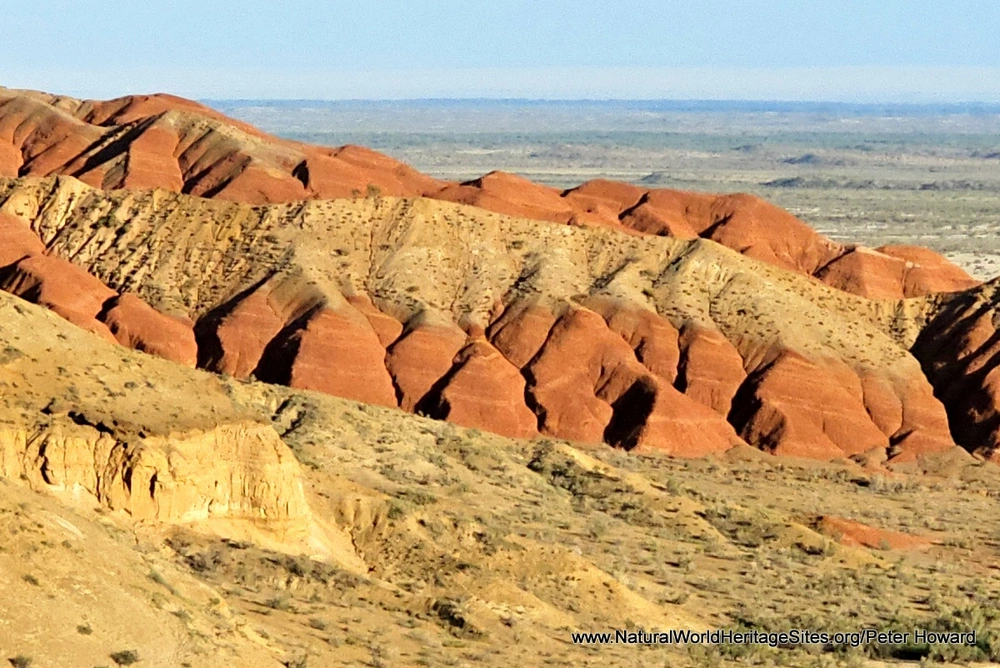
Slideshow Description: The slideshow ‘tells the story’ of the Cold Winter Deserts of Turan with a portfolio of photos that illustrate the landscape features of three quite different components of the site, starting with Kazakhstan’s Altyn-Emel National Park, followed by parts of the Ustyurt plateau area and finally a few images of Turkmenistan’s Karakam Desert.
The photos of Altyn-Emel National Park are by Peter Howard, while Nigel Dudley and Sue Stolton (Equilibrium Research) are thanked for their contributions of photos from the Ustyurt Plateau and Karakam Desert.
Factfile
Website Categories:
Area: 33,664 km2
Inscribed: 2023
Criteria:
- Ecological processes (ix);
- Natural habitat for biodiversity (x);
- Significant number of rare, endemic and/or endangered species (x)

